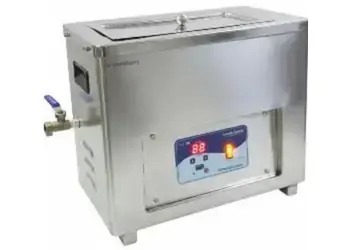
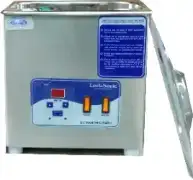
Key Features
- Lab Essential: Ideal for cleaning beakers, flasks, pipettes, sieves, small parts and lab tools.
- Digital Controls: Microcontroller-based timer + heater for repeatable, consistent lab cycles.
- Degassing & Mixing: Helps degas HPLC solvents/buffers and improves mixing/dissolution of powders.
- Durable Tank: Die-pressed seamless SS 304 tank for long life and easy maintenance.
Technical Specifications
| Capacity | 1.5L, 2.5L, 3.5L, 6L, 10L, 20L, 30L 7 options |
|---|---|
| Frequency | 33 kHz / 40 kHz (gentle & effective cavitation) |
| Tank Material | SS 304 construction – seamless die-pressed tank |
| Heater | Digital Control (Ambient to 80°C) |
| Timer | Digital timer (0–99 mins) for repeatable lab cycles |
| Ultrasonic Power | High-efficiency transducers with ~200–500W (tank-size dependent) |
| Accessories | SS Lid & Wire Mesh Basket included (model dependent) |
Price Range (India)
₹10,000 – ₹65,000 (depending on capacity, heater/timer options and accessories). For exact pricing, share your required capacity and application.

Opens in YouTube (does not load iframe here, so mobile performance remains high).
Ultrasonic Sonicator Bath & Laboratory Ultrasonic Cleaner
The LeelaSonic Ultrasonic Sonicator Bath is a dependable lab ultrasonic cleaner used for cleaning laboratory glassware, degassing HPLC buffers/solvents, dissolving powders and mixing samples. It is widely used in schools, colleges, pharma labs, research labs and QC departments across India.
Ultrasonic waves create controlled cavitation that reaches complex shapes and hidden corners where brushes cannot. This makes it suitable for glassware cleaning, removing residues from tools/instruments (pre-cleaning), and improving repeatability in sample preparation.
Need stable low temperature? For proteins/enzymes and heat-sensitive samples, use Ultrasonic Bath with Chiller. For high-intensity processing, choose Ultrasonic Probe Sonicator.
Application Notes
For pharma labs, degassing, sample prep, and lab workflows, see the application guide.
View Pharma & Lab Sonication ApplicationsLaboratory Applications
- Glassware Cleaning: Beakers, burettes, flasks, test tubes and measuring cylinders.
- Sample Preparation: Dissolving salts/powders, reagent mixing, gentle dispersion.
- HPLC & Analytical: Degassing solvents / mobile phases and buffer solutions.
- Scientific Instruments: Cleaning sieves, filters, small components, lenses (as applicable).
- General Parts: Small mechanical parts and electronics (application dependent).
Tip: Use the correct cleaning liquid and avoid direct cleaning of assemblies that can trap liquid unless your process includes proper rinsing and drying.
The LeelaSonic sonicator bath is also known as an ultrasonicator bath, water bath sonicator, sonication machine or ultrasonic bath sonicator — all referring to the same tank-based system. As a leading sonicator bath manufacturer in India, LeelaSonic supplies factory-direct to 500+ pharma labs, research institutes and hospitals across India. Sonicator bath price starts from ₹10,000.
Sonicator Machine Types: Bath Sonicator vs Probe Sonicator
A sonicator bath (also called an ultrasonic bath sonicator, sonication bath or water bath sonicator) is a stainless-steel tank filled with water. Ultrasonic transducers bonded under the tank send sound waves through the water, so many beakers, flasks or vials can be sonicated together without touching the sample. It is the most common lab sonicator in pharma QC, R&D and college laboratories.
A probe sonicator puts a titanium horn directly into one sample. It gives much higher energy for cell lysis, nano-dispersion and homogenisation, but treats one sample at a time.
| Point | Bath Sonicator | Probe Sonicator |
|---|---|---|
| Best for | Degassing, dissolution, mixing, glassware cleaning | Cell lysis, nano-dispersion, emulsions |
| Samples at once | Many (indirect, through water) | One (direct contact) |
| Contamination risk | None – sample stays in its own container | Probe touches the sample |
| Budget | Lower | Higher |
Which Ultrasonicator Bath Size Do I Need?
- 1.5L – 3L: small labs, a few vials or 100 ml flasks, HPLC mobile-phase degassing.
- 6.5L – 10L: pharma QC labs – 500 ml / 1 L volumetric flasks, tablet dissolution.
- 20L – 30L: large glassware, burettes, pipettes and high sample load.
- Heat-sensitive samples: long sonication warms the water – choose the ultrasonic bath with chiller.
Sonicator Bath Price in India – What Changes the Price?
- Tank capacity – a bigger tank needs more transducers.
- Heater – with or without digital temperature control.
- Timer – analogue or digital.
- Frequency – standard 33 / 40 kHz.
- Accessories – SS lid, basket, flask holder or beaker rack.
LeelaSonic sonicator baths start from ₹10,000. Because we manufacture in Dombivli (Thane), you buy factory direct – no dealer margin, quick service and spares across India.
Frequently Asked Questions
LeelaSonic sonicator baths start from ₹10,000 for small lab models. The final price depends on capacity (1.5L–30L), heater, timer and accessories. Call +91-98205-74207 for today's price.
Yes. Sonicator bath, ultrasonic bath, sonication bath and water bath sonicator are different names for the same machine – a tank of water with ultrasonic transducers underneath.
A bath sonicator treats many closed samples together through water and is used for degassing, dissolution and cleaning. A probe sonicator dips a titanium horn into one sample and gives much higher energy for cell lysis and nano-dispersion.
No. An ultrasonic bath is a cleaner, not a sterilizer. It removes dirt, blood and residues effectively, but instruments must still be autoclaved afterwards for sterilization.
For general lab cleaning, deionized water with a mild detergent is sufficient. For specific contaminants, use a compatible solution/solvent suitable for SS304 and your sample.
Yes. It is commonly used for degassing HPLC solvents/buffers and removing dissolved gases from mobile phase before analysis.